How did you learn about MLS laser therapy?
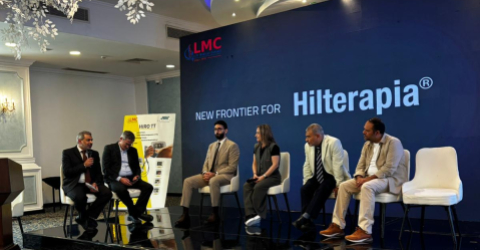
My wife and I decided to go to the World Association of Laser Therapy thirty-year anniversary conference in London, which was amazing to see the cutting-edge research in photobiomodulation therapy.
And it was there that I bumped into another Aussie, Catherine Norton, who I hadn't met before, and that's when I was introduced to ASA as a laser therapy company.
When we returned to Australia after that, there happened to be an ASA conference in Melbourne late last year, and I decided to head down there and spend some more time learning more about the ASA company.
And that's when I saw the M-Hi machine.
Why did you choose M-Hi?
I chose M-Hi because it blew me away, to be honest.
I recall very clearly, I went to the Melbourne conference, and I came back home, and my wife, Kate, asked me how it was, and she could see that I was buzzing, full of enjoyment, just with this technology and this machine.
And then within about an hour or two, we'd rung Catherine or texted Catherine to say, "We'll buy it."
And so we got the first M-Hi in Australia.
It was just very, very portable, practical, really professional, very user-friendly.
And when I saw the technology and just the whole patented MLS® system, I hadn't seen that before. My other machines don't use that.
So when I saw that technology, I was really taken with that.
What benefits have you seen in your patients after laser treatments?
I've got other laser machines that I previously used, and there were quite a few patients with chronic conditions that were responding, but slowly.
And then when I got the M-Hi machine late last year, on a number of occasions, patients said to me, "That new machine, I don't know what's different, but since then, there's been a real improvement in my condition."
So I found it sped up the healing process, and treatment times are shorter, and the results are a lot quicker.
Which conditions do you treat mostly with laser therapy?
As I'm from a chiropractic background, it's mostly musculoskeletal at this stage. I'd like to head into wound healing, which I've had a couple of wound patients as well. And then also the neurodegenerative type disorders I want to start to head into as well. But primarily at the moment, it's musculoskeletal.
So all your bursitis. Hip bursitis responds ridiculously quickly. It's a very debilitating condition, and it gives patients a lot of pain, particularly the elderly with hip bursitis.
It affects their whole life. They can't sleep. They can't do their normal activities of daily living, gardening or bowls.
And usually within two to four sessions of laser therapy, hip bursitis responds really, really well.
Shoulder bursitis, muscle tears respond really well. Strains, sprains and contusions, ankle sprains, like rolled ankles, respond really, really quickly. And particularly when you see the hematomas and those sorts of things, that's something that the patients can really see.
Normally it'd be four to six weeks with all the different colorations of the hematoma. Usually within sort of seven days, it's almost completely disappeared. So those sorts of things are pretty cool for the patient to see.
And then general aches and pains, neck pain, neurological conditions, disc herniations, those sorts of things. Inflamed nerves respond really quickly to laser therapy. And another one which is really surprising is peripheral neuropathies.
I've had some patients that have had a diagnosis of peripheral neuropathies, even chronic, like two, three years. And usually within four to six sessions, there is some level of improvement in their sensation in the feet, which is quite amazing, particularly from a medical point of view.
Peripheral neuropathy is a very challenging condition.
What feedback did you receive from your patients after the treatment?
It varies. Some people say, "Is the machine on?"
And once you sort of educate them on what's happening, because a lot of times, being a chiropractor, they like to feel they're getting something done or some sort of manual input.
That's another thing I like with the M-Hi, because of the way it's set up with the diodes, you can actually use it as a manual massage type thing as well while you're getting the laser therapy.
Most times patients will get up off the table, whatever their condition is, and they'll look at me and say, "Is it supposed to work this quick?"
So that's really good.
Like, you do your tenderness, your range of motion sort of thing, pre- and post-treatment. And oftentimes, even when they're walking out of the clinic, you can see they're walking better and they're starting to smile.
So that's something that really blows me away, just the speed that people respond. Obviously, not everyone responds as fast, but usually within that first one to two sessions, there is some level of response or improvement, and I know we're on the right track.
Please describe ASA in three words.
I was gonna say cool.
It's a very professional system and a very professional company.
And I can tell you by the way it's designed, there's been love and passion put into it.
And it's very user-friendly. I'm very IT dinosaur-ish, so I need something that's very easy to use.
It was only three words, wasn't it?
Professional, portable, and effective would be the three words I use for ASA.
So if anyone's looking to get into laser therapy, it would be very easy to integrate into any allied health practice: physiotherapy, chiropractic, myotherapy, osteopathy.
I highly recommend it.