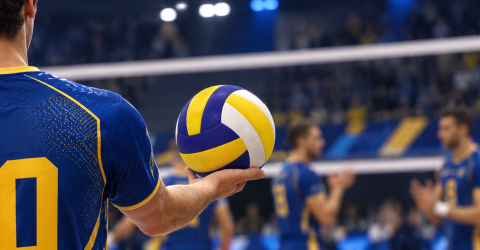
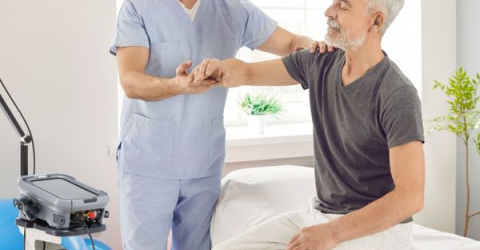
I'm François Molinaro, a physiotherapist and sports therapist, and I've been working for fifteen years at Kiné Forme Wasquehal, a sports physiotherapy practice in Wasquehal. We treat numerous players, athletes of all levels, from all sports, and even some clubs, in a multidisciplinary setting with several colleagues.
François, why did you decide to integrate laser therapy into your practice? And what was the reason behind your decision?
Simply because, when we opened the practice, we had to choose between different physiotherapy equipment items. At that precise moment, about thirteen years ago, we had the opportunity to discover laser. At the time, other therapies were still being used, such as shock waves or, in some practices, ultrasound. We, however, wanted to stand out and focus immediately on what was most modern and innovative. So we chose laser.
You use both MLS® and Hilterapia®. Why have both technologies available, and what are the advantages for the practice?
First of all, we're fortunate to have both. We started, as often happens, with MLS®, achieving excellent results. Subsequently, as the practice, the team, and the sports activities grew, the need for new tools arose. We then tried Hilterapia®, and thanks to their different modes of use and effects, it was useful to have two technologies from the same company that are complementary. This allows us both to diversify our treatments and to always have a device available for practical reasons.
What pathology do you primarily treat with MLS® Laser Therapy?
With MLS®, we focus primarily on analgesia and anti-inflammatory effects. The field of application is very broad, so we use it extensively.
And with Hilterapia®?
With Hilterapia®, we focus primarily on tissue repair. The great added value is the high intensity, which promotes tissue regeneration and the treatment of issues, including osteopathic ones.
What is the feedback from your patients after the treatments?
It's good. It's good, and this has been true right from the start. Laser therapy allows us to better manage pain and to adopt a more effective approach, allowing us to transition more quickly to active therapies. For a sports physiotherapist, the goal is a return to activity: recovery times are reduced, and protocols are quicker and more effective.
This is the appeal of having laser therapy at your fingertips.
Could you describe ASA in three words?
First of all, I'd say knowledge: since I discovered ASA, it's clear there's a solid scientific foundation behind it, based on studies and research. Then, mastery: you can clearly perceive great expertise in managing the technology and the device intensities. Finally, uniqueness, especially for Hilterapia®, which represents a distinctive approach and guides us towards new technologies that are truly very interesting for us physiotherapists.